
Anyone can rent a fixer and get eighteen months of improvement. The Numenis 19 is the standard for the other kind of turnaround — the kind that holds after the turnaround leader leaves. Five acts, nineteen disciplines, and beneath each one, the question to ask at your next board meeting to find out where you stand.
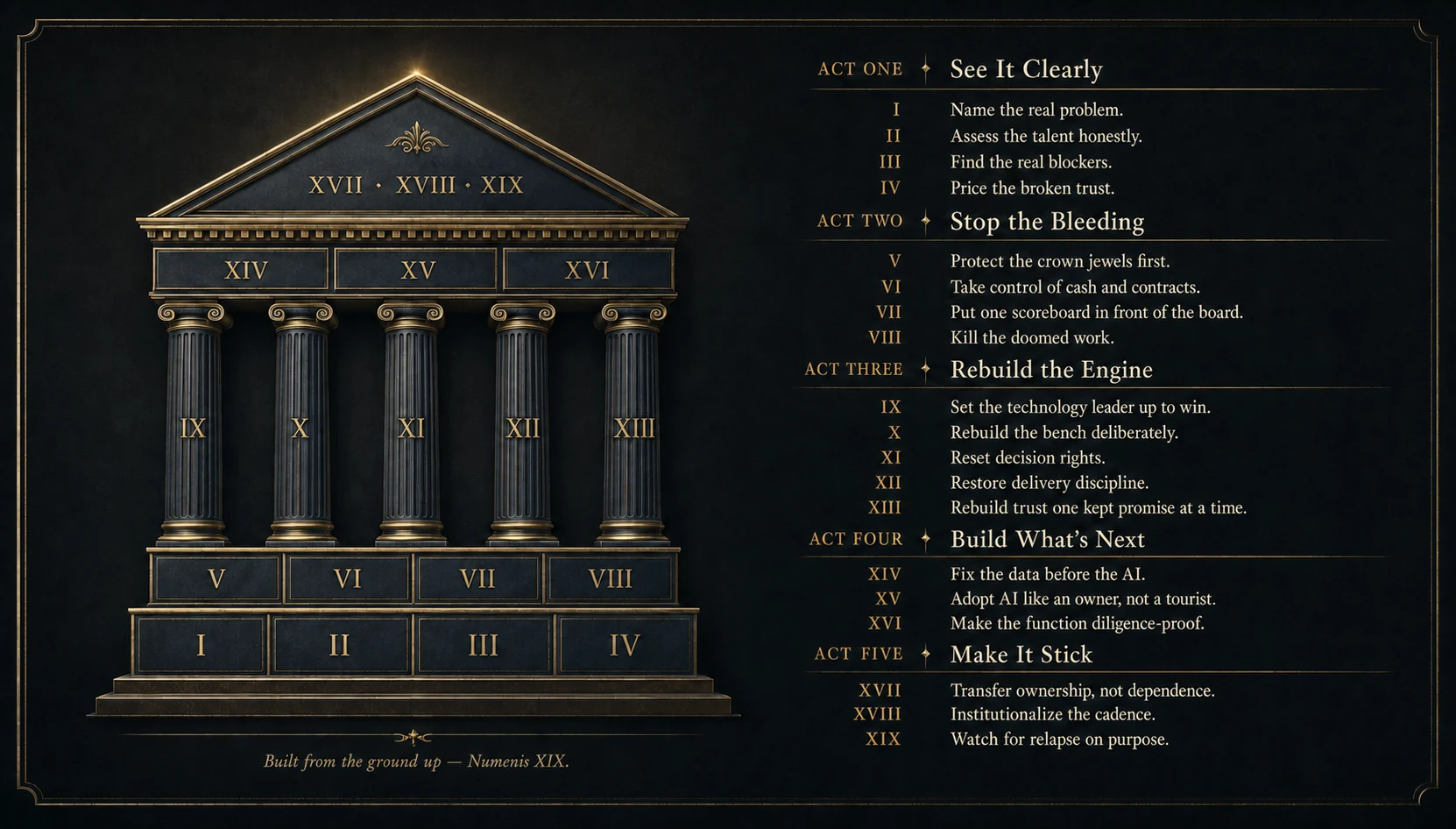
Before a dollar is spent. Most failed turnarounds fail here — they fix the wrong problem well.
Most technology failures are leadership failures wearing a technology costume. Diagnose which one you actually have — systems, people, or operating model — before you buy anything.
Do we actually know whether our problem is the software, the people, or the way decisions get made?
Rate every technology leader on capability, values, and ego — the Talent Triangle — before deciding who runs the rebuild, who supports it, and who exits.
If we were starting fresh tomorrow, who in technology leadership would we rehire?
Stalled implementations are rarely stalled by software. Surface the political, process, and data blockers that the status reports will never name.
What does the project team believe that the steering committee never hears?
When the business stops trusting IT, it routes around it — shadow systems, rogue spend, decisions made without the data. Measure where trust broke and what it is costing.
Where has the business quietly built its own workarounds?
Stabilization is triage, not strategy. Its job is to buy the turnaround time and credibility.
One breach ends a turnaround — and sometimes a company. Close the exposures that can kill you while everything else is being repaired.
What are our five biggest exposures today, and who owns each one by name?
Vendor sprawl, duplicate tools, and quiet auto-renewals hide inside every troubled function. A disciplined turnaround funds itself out of the waste.
Could anyone in this room name our ten largest technology contracts and what they renew for?
One honest page: status, risk, spend, and what changed. Executive visibility is the difference between governance and surprise escalations.
When were we last surprised by a technology problem — and why did it reach us late?
Momentum is not progress. Stopping a project that cannot succeed is a victory, and every doomed initiative is funding stolen from a necessary one.
Which of our current initiatives would we refuse to start today, knowing what we know?
The longest act, and the one where turnarounds are won: leadership, operating model, and earned trust.
The right CIO fails without a clear mandate, real authority, and visible air cover from the CEO and board. Enable first — then hold ruthlessly accountable.
Does our technology leader know exactly what winning looks like — and would we give the same answer?
The team below the leader determines whether change survives. Fill the seats that would break you first, using capability, values, and ego in balance — never résumés alone.
Which seats would break us if the wrong person sat in them for a year?
Who decides, who funds, who is accountable. When decision rights are ambiguous, every project becomes a negotiation and every escalation lands on the CEO.
Can our people name who decides — without scheduling a meeting to find out?
Fewer things, finished faster. Cadence beats heroics — heroics are how the function got here.
What did technology ship last quarter that the business actually noticed?
Trust does not return with a reorg announcement. It returns transactionally — small commitments, kept on time, kept visibly, compounding.
What has IT promised the business this quarter, and did it land on the date given?
A turnaround that only restores yesterday's function has failed quietly. It must leave the company ready for what's coming.
AI amplifies whatever it finds. On a broken data foundation, that means confident, scaled, expensive mistakes. Foundation first — then intelligence.
Would we bet a customer relationship on our data being right?
Strategy before pilots. A gatekeeper before vendors. Production before demos. The companies winning with AI are disciplined, not early.
How many AI pilots do we have running — and how many have reached production?
Whether or not a sale is planned, build technology that a buyer's diligence team would respect. Diligence-proof is simply another name for well-run — and it protects the multiple.
If technology diligence started Monday, what would it find?
The act everyone else skips — and the reason Numenis mandates end while their results don't.
A turnaround isn't finished when the turnaround leader leaves; it's finished when permanent leadership owns the machine and doesn't call for help. A mandate should end. A dependency never does.
What happens in the ninety days after the turnaround leader walks out the door?
Reviews, governance, and delivery habits must belong to the institution, not the personalities who installed them. If a discipline dies when a person departs, it was never a discipline.
Which of our new operating habits would survive the next leadership change?
Regression announces itself early — slipping cadence, returning heroics, quiet new workarounds. Assign an owner to watch the signals, and give the board the short list of what to listen for.
Would we know within one quarter if the mess was coming back?
In a single confidential conversation, we can walk the nineteen together and score each one red, yellow, or green. Most leadership teams are surprised by what they can't answer — and know exactly what to do next.
Book a 30-minute 19 ScoreThirty minutes with a principal. No fee, no deck. If the reds point to something bigger, the 30-Day Turnaround Assessment is the next step — $45,000, fixed fee, credited in full against a mandate.